
Strategic Wealth Management in an Unpredictable Economy
In today’s rapidly shifting economic landscape, achieving true financial freedom requires more than just high income; it demands the cultivation of financial resilience. As global markets fluctuate, shifting the focus from mere “saving” to “strategic wealth management” is essential for long-term security.
The Foundation: Dynamic Budgeting and Cash Flow
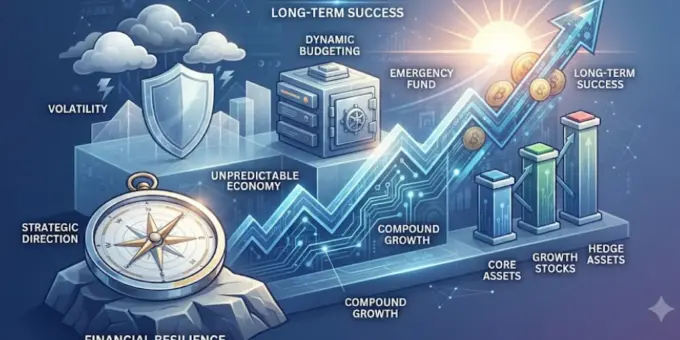
The era of rigid, static budgets is fading. Modern wealth management prioritizes Dynamic Budgeting, which adapts to inflation, cost-of-living adjustments, and shifting personal priorities. By leveraging automated tracking tools, individuals can move from reactive spending to proactive capital allocation. Ensuring a robust emergency fund—ideally covering 6 to 12 months of expenses—remains the first line of defense against unforeseen economic downturns.
Strategic Asset Allocation
Diversification is the bedrock of risk management, but true resilience comes from Strategic Asset Allocation. Instead of keeping capital stagnant in low-yield savings accounts, successful individuals employ a multi-layered approach:
-
Core Portfolio: Low-cost index funds or ETFs that capture long-term market growth.
-
Growth Assets: Tactical investments in emerging technologies or sectors with high potential for disruption.
-
Hedge Assets: Commodities, real estate, or digital assets that act as a buffer against currency devaluation and market volatility.
The Power of Compound Interest and Time
Financial success is often a byproduct of patience. Harnessing the mathematical power of compound interest—what is often called the “eighth wonder of the world”—requires starting early. Even modest, consistent contributions to an investment portfolio over several decades often outperform sporadic, large-sum investments due to the compounding effect on reinvested dividends and capital gains.
Debt as a Tool, Not a Burden
Resilient wealth management changes the relationship with debt. It shifts the perspective from “all debt is bad” to “leveraging debt for growth.” Using low-interest credit to acquire cash-flowing assets is a fundamental strategy used by savvy investors to accelerate net-worth growth. However, this requires strict discipline and a deep understanding of debt-service-coverage ratios.
Cultivating a Financial Mindset
Beyond the numbers, the most significant factor in wealth creation is the psychology of money. This involves overcoming behavioral biases such as loss aversion and herd mentality. Those who remain committed to a long-term plan, regardless of daily market noise, are the ones who ultimately build generational wealth.
Conclusion: Financial resilience is not a destination but a continuous process of learning, adapting, and executing. By integrating dynamic budgeting, strategic asset allocation, and a disciplined investment mindset, you can navigate economic uncertainty not just with survival, but with sustained growth.
